Lead a Project Night
Prepare for Project Night, build your team, and make the most of your time together.As important as the tool or service you’re building is, the team dynamic matters just as much. Project Nights are where contributors can work together on the project. As a Project Lead, having good organization helps make it easier for new folks to participate and gives projects the structure they need to keep moving.
This guide covers the basics of preparing for Project Night, building your team, and making the most of your time together.
Prepare for Project Night
Section titled “Prepare for Project Night”Organization is fundamental. Without it, good intentions and talented contributors can get lost. While every project operates differently, there are a few basics that help make Project Nights welcoming for both new and returning contributors.
-
Have a project one-pager. Create a one-pager that describes your project, its mission, and the skills needed. While this information may already be available on the website or GitHub, having everything in one place makes it MUCH easier to onboard newcomers. Be sure to include links to your Slack, GitHub, and any software they may need to download. One tip is to print out copies and pass them around to newcomers during Project Night.
-
Identify roles and responsibilities. You should have a sense of the roles and responsibilities that your project needs. When people know what skills are needed, they’re more likely to commit longer term. This can live on a project board in Slack, where it’s visible to everyone and should be updated as the project evolves.
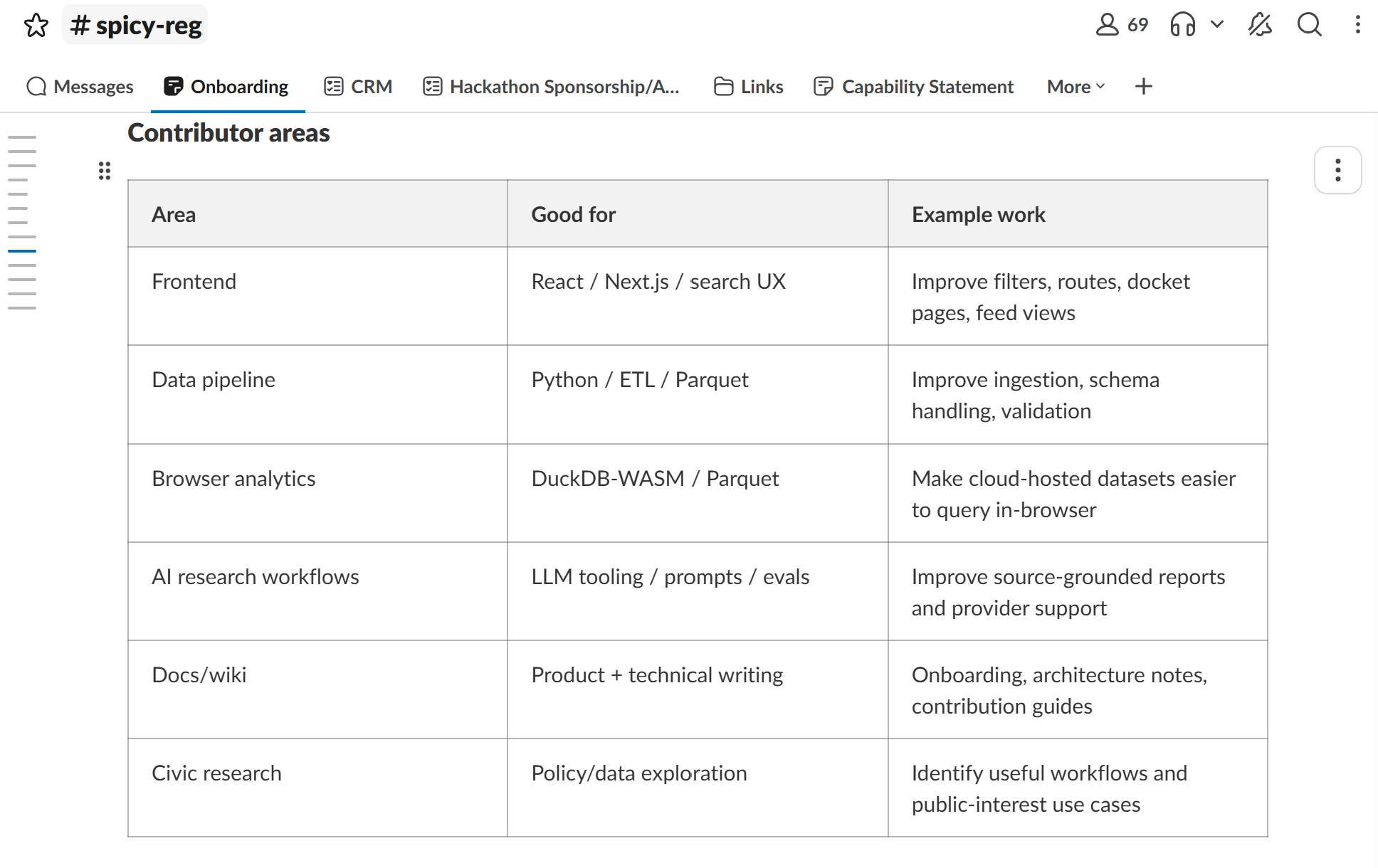
Here are the roles of Spicy Regs from their Slack project board. -
Keep running meeting notes. You should keep a running list of meeting notes to stay effective and know what is going on. Even a few brief bullet points after each Project Night keep everyone on track and prevent work from being repeated. This is especially important when contributors cannot attend every Project Night and would value a quick catch-up.
-
Establish a meeting cadence. You should have some cadence of meetings. This can just be the regular Project Nights, or it can be occasional virtual meetings. Some contributors only want to work during Project Nights, and some want to work a lot in between. As a Project Lead, you should adjust based on the desires of the team and time-sensitive milestones you have.
Build Your Team
Section titled “Build Your Team”First impressions matter. A person’s first Project Night can determine whether they come back.
Project Nights are as much about building a community as they are about building technology. Building a healthy project team means making it easy for newcomers to feel welcome and understand what your team is working on.
Supporting New Contributors
Section titled “Supporting New Contributors”- Identify beginner-friendly tasks. Label beginner-friendly tasks as
good first issueon GitHub or your project board. These should be real, self-contained tasks, not busywork, that give new contributors a sense of accomplishment and help them understand how the project operates. Ideally, have a few tasks ready before each Project Night so newcomers have something to work on. For reference, newcomers can also find guidance in the Your First Contribution guide under the Join section. - Have an onboarding process. This could be a walkthrough during Project Night or a personal onboarding session for contributors who want to go deeper.
- Be realistic about your capacity. As a Project Lead, you’re balancing welcoming new contributors, organizing Project Night, and making progress on your project. You won’t always have time to onboard every new contributor individually. Some projects have a dedicated onboarding coordinator, which is something to consider for your own team. You can also point newcomers toward documentation or connect them with another team member who can help. The important thing is to make sure no one feels ignored or left out.
- Follow up on contributions. Aim to respond to any questions or first contributions within a couple of days. A quick acknowledgment, even “Hey, I’ll review this by the end of the week,” goes a long way in letting the newcomer know they are not being ignored.
Recognizing Strengths
Section titled “Recognizing Strengths”Ask people what they want to do, not just what their formal background says. A policy analyst might want to try their hand at data wrangling; a developer might want to write documentation. Project Nights are an opportunity for people to contribute their existing skills while also learning something new.
This means creating clear roles for your team and listing them on Slack, your website, or wherever you organize your project. Named roles, even informal ones like “data lead” or “community liaison,” help give people something to grow into.
Also, make sure to recognize people’s contributions publicly! Some ideas include:
- Invite contributors to give the project pitch at Project Nights. It is a good way for them to practice their public speaking skills and succinctly deliver a quick pitch. It also visibly signals that leadership isn’t concentrated in one person.
- Recognize contributions Give a thank-you when someone finishes a task or helps onboard a new member. Make your thanks specific (“Thanks to Maya for cleaning up that data pipeline”).
- Allow people to take ownership of part of the project. When contributors feel responsible for something, they’re more likely to stay invested in the project’s progress. Give people the trust and flexibility they deserve.
Run Project Night
Section titled “Run Project Night”Project Nights are very individualized, with some teams working together while others break into smaller groups. What matters is strong organization and clear next steps.
Before Project Night
Section titled “Before Project Night”Try to have a sense of what your team will be working on before the event. This doesn’t mean planning every minute, but having an agenda is helpful and prevents wasted time.
- Identify a few priorities for the night. These could be features to build or decisions that need to be made. We recommend saving larger discussions and team decisions for Project Night, when everyone is together and can contribute.
- Check for blockers. If a task requires access to a repository, a dataset, or information from a community partner, try to address those needs ahead of time.
Project Pitch
Section titled “Project Pitch”This is the best time to share your project. There is a room full of people who care about civic tech and are actively looking for something to contribute to.
Please keep your pitch to 30 seconds or a minute. The longer you take, the less time you have for the actual project work. A tight pitch also signals that you respect everyone’s time, which earns goodwill. Practice saying it out loud before the event so it feels natural.
You can break your pitch down into three parts: what your project is and what problem you are trying to address, what you are working on this Project Night, and what both technical and nontechnical skills you are looking for.
Update the master slides frequently so the information is current. Since this is a public playbook, the slides may appear in view-only mode, but all Project Leads have editing access.
Establishing a Rhythm
Section titled “Establishing a Rhythm”Be realistic about what your team can accomplish. It’s easy to get excited about new ideas, especially when new contributors bring different perspectives. Take ideas seriously but also recognize that not every idea in the moment needs to become the next biggest priority. Focus on a few things your team can realistically accomplish with the time and skills available. It’s better to make steady progress than to have too many things happening at once.
It is up to you how you structure your Project Nights. Some Project Leads jump straight into tasks and pause for introductions when newcomers arrive after their new member orientation. One approach is to start with a brief check-in, spend most of the evening working on tasks, and leave the last few minutes to share progress and identify next steps. However, you should find a structure that works for your team’s size and the number of new contributors joining.
Some projects may not have a dedicated new member orientation, especially when there’s already a lot to accomplish during the few hours of Project Night. In these cases, having that one-pager ready can be especially helpful! Regardless of how your team handles onboarding, make sure newcomers are acknowledged. A simple “glad you’re here!” or a follow-up message on Slack can help people feel welcome.
Don’t dominate the conversation during Project Nights. It’s important to let other people lead discussions and talk about what they are working on. Your job as Project Lead is to guide the team, but also know when to step back and give others space.
At the same time, be mindful of conversations that take up too much time. Discussions are important, but try to make sure people still have time to contribute to the actual work.
Disagreements are a natural part of working with a team, especially when people bring different experiences to the project. Give people space but try to keep discussions focused on the problem you’re trying to solve rather than individual preferences. Not every disagreement needs to be resolved during Project Night, and some conversations may be better continued outside of the event.
After Project Night
Section titled “After Project Night”Remember what we said about first impressions? New member enthusiasm can wane VERY quickly, so it is recommended to check in with them and write a welcome message in Slack. Reference something specific from the conversation, such as what they said they were interested in or what issue they were going to look at, so it feels personal rather than automated.
For returning contributors, follow up on any outstanding tasks or questions that came up during the session. Update your meeting notes or project board so that people who could not attend can still follow along.
Remember that not everyone will be able to contribute between Project Nights. That is okay; the goal is to create a flexible project environment.
Maintain Momentum Between Project Nights
Section titled “Maintain Momentum Between Project Nights”While Project Nights are the core of Civic Tech DC’s programming, some projects may benefit from additional meetings or communication between events. How much happens between Project Nights depends on the team’s interests and any time-sensitive milestones. For example, if you are planning for a hackathon, you might have one or two virtual meetings.
-
Find a meeting cadence that works for your team. This might mean only working during Project Nights, having occasional virtual check-ins, or meeting more regularly when working toward a deadline. You don’t need to meet every week for your project to be successful.
-
Keep communication open without expecting everyone to be constantly available. Not everyone will respond immediately via Slack, email, or whatever other communication tool you are using, and that’s okay.
-
Stay connected with your community partner. If your project is working with a nonprofit, government office, or community organization, make sure you or another team member can be the liaison. Give regular updates and ask for feedback throughout the process.
Finally, remember that progress in volunteer projects is not always linear. Some Project Nights will be more productive than others, and there may be periods when contributors are less available. What matters is keeping enough structure in place that people can return.
For guidance on keeping your partner involved, see Working With Community Partners.