Grow a Project
Learn how to grow awareness of your civic tech project, reach your audience, host activities, and communicate your project.Building the technical application of a project is only the first step. For people to know why your project exists and why they should care, you need to think about how to grow awareness. This means having a clear and engaging story and creating opportunities for others to use and support your work.
This guide covers the basics of communicating your project and turning interest into meaningful involvement.
What Does Growth Mean?
Section titled “What Does Growth Mean?”Before jumping into outreach, think about what your project actually needs. For example:
- A project developing a public-facing tool might want to reach more users and gather feedback on how people are using it.
- A project working with government data might focus on building relationships with government agencies.
- A research-focused project might want to publish findings and share them with researchers.
- A project with an established user base might focus on maintaining its work and building long-term partnerships rather than recruiting more contributors.
You don’t need to do everything at once. In fact, trying to grow in too many directions can take time away from the actual work. Think about what would make the biggest difference for your project right now and focus your efforts there.
Do Tell a Story
Section titled “Do Tell a Story”People connect with people, not software. When you talk about your project, start with the problem you are trying to solve and the people who experience it.
Try to avoid leading with technical details. The technology is important, but it should help explain how you are addressing the problem. It is also important to think about who you’re talking to. A resident might want to know how a tool can help them, while a government agency might be more interested in how it could support existing services or address a problem they’re already working on.
Here is an example of how the same project might be described to different audiences:
To a resident:
“DC Benefits Finder helps you figure out what utility assistance programs you may qualify for without having to search through multiple government websites. All you need to do is answer a few questions about your household, and the tool shows you programs that may be a good fit and where to apply.”
To a government agency:
“DC Benefits Finder helps residents identify utility assistance programs they may qualify for by bringing information from multiple government websites into a centralized system. The tool can help connect residents with the right resources while reducing the time staff spends directing people. Since launching, 2,000 residents have used the tool, and three community organizations are using it.”
Both descriptions explain the same project, but they focus on different things depending on what the audience would find most relevant.
Write a Mission Statement
Section titled “Write a Mission Statement”One of the easiest ways to communicate your project is to have a clear, jargon-free description of what it does and who it helps. This becomes your pitch at Project Nights, your description in your GitHub README, and your description on Slack.
Your mission statement should answer three basic questions:
- What problem does the project solve?
- Who is it for?
- What stage is it at?
Try to write it so that someone who has never heard of your project can understand it in less than a minute.
Your mission statement can change as the project develops. Early on, you may be describing the problem you are exploring and what you hope to build. Later, you may be able to describe the people using the project and what you have built.
One of the best things about a mission statement is that it helps you stay focused. As a project grows, it becomes easy to want to go in different directions or add new features. Revisiting your mission statement regularly helps you decide what is most useful for the project and what is not.
Communicate Your Impact
Section titled “Communicate Your Impact”People want to contribute to (and fund) a project that has tangible impact. Keep track of metrics and other evidence both to tell your story and to help you and your team understand whether the project is working. This could include how many people are using the project, how many organizations are involved, feedback from users, or changes the project has helped make.
It is also helpful to distinguish between what your project has accomplished and what has changed because of it. For example, launching a website is an accomplishment, but understanding whether people are using it tells you more about its impact.
Also, keep this information somewhere your team can reference it! It will be useful when talking to potential partners or giving presentations.
Do Boost Your Visual Communications
Section titled “Do Boost Your Visual Communications”Everyone loves a good logo or a well-designed website! Having a few visual materials can help make your project more recognizable and is also a great way to welcome designers and communicators onto your team. Here are some ways to get started:
Create a Website
Section titled “Create a Website”All Civic Tech DC projects have a mini page on the Civic Tech DC Projects website, but it’s nice to have your own website that you can own and control! If you do create a website, keep it simple and easy to maintain. Make sure the information is current and someone on the team is responsible for updating it when needed.
Astro is a good option for civic tech projects since it’s free, open source, and great for content-focused websites without requiring a lot of frontend experience. In fact, this playbook is built with Astro! You can also try GitHub Pages. AI tools can help you get a first version up quickly, but make sure the final website reflects your project and that your team knows how to maintain it.
For example, CIB Mango Tree has its own website at cibmangotree.org. You can also check out the website’s source code on GitHub to see how it was built.
Use Social Media
Section titled “Use Social Media”You are welcome to use Civic Tech DC’s LinkedIn to help spread the word about your project. LinkedIn is where much of DC’s professional community is active, especially if that is your main target audience. Some good ideas for posts include:
- Project milestones: Share a new feature or accomplishment.
- Contributor spotlights: Recognize your amazing team!
- Upcoming events: Promote a hackathon or workshop.
- Calls for contributors: Let people know what skills or help your project is looking for.
To request a post through Civic Tech DC, fill out the social media request form. You also have access to Canva if you need to create graphics. The organizers will schedule your post, and depending on how frequently your project wants to use LinkedIn, we may also give you access to the LinkedIn page.
You are also very welcome to create your own social media accounts! CIB Mango Tree has both a LinkedIn and an Instagram account.
Create a Logo
Section titled “Create a Logo”Canva has free templates that are a good starting point. Aim for something simple that works at small sizes, like a Slack avatar, and larger sizes, like a slide header.
Have a Pitch Deck
Section titled “Have a Pitch Deck”A pitch deck gives you something polished to share when presenting at events or reaching out to partners. Google Slides and Canva are great platforms because they are easy to use and allow multiple contributors to collaborate and update the deck. Keep your pitch deck short and snappy. Focus on the most important information and use visuals whenever possible rather than filling slides with text.
Spicy Regs pitch deck example (PDF)
Do Get the Word Out
Section titled “Do Get the Word Out”Get Your Story Featured
Section titled “Get Your Story Featured”Check out local news outlets and publications to help spread the word about your project! You can also reach out to journalism students at local universities who might be interested in covering your work.
When talking to the press, focus on the story behind your project. How did it get started? Who came together to work on it? What problem are you trying to solve? Sometimes the people and experiences behind a project make for a more interesting story than the technology itself.
For example, one of the first articles about CIB Mango Tree was Meet the Team Using Social Media Analysis as a Tool for Social Change. The article was written by a journalism student whom the team connected with through a mutual acquaintance. It’s a good reminder that opportunities for coverage don’t always come through traditional media outreach. Sometimes they start with someone in your network!
Let the Civic Tech DC organizers know about particularly interesting developments. There may be opportunities to help amplify your work through the organization’s network.
Host Activities and Events
Section titled “Host Activities and Events”You are welcome to host different events outside of Project Nights to help your project grow. This could mean partnering with another organization for a demo, hosting a hackathon, or organizing a meetup where people can try out your project and provide feedback.
Civic Tech DC can also help you organize an event, including coordinating food and finding a venue with enough advance notice. If you’re interested in organizing an event, fill out the organizer request form.
You also do not necessarily need to host your own event. Sometimes presenting at an existing meetup or event is a better use of your team’s time.
Example: Lightning Demos with Congressional Tech
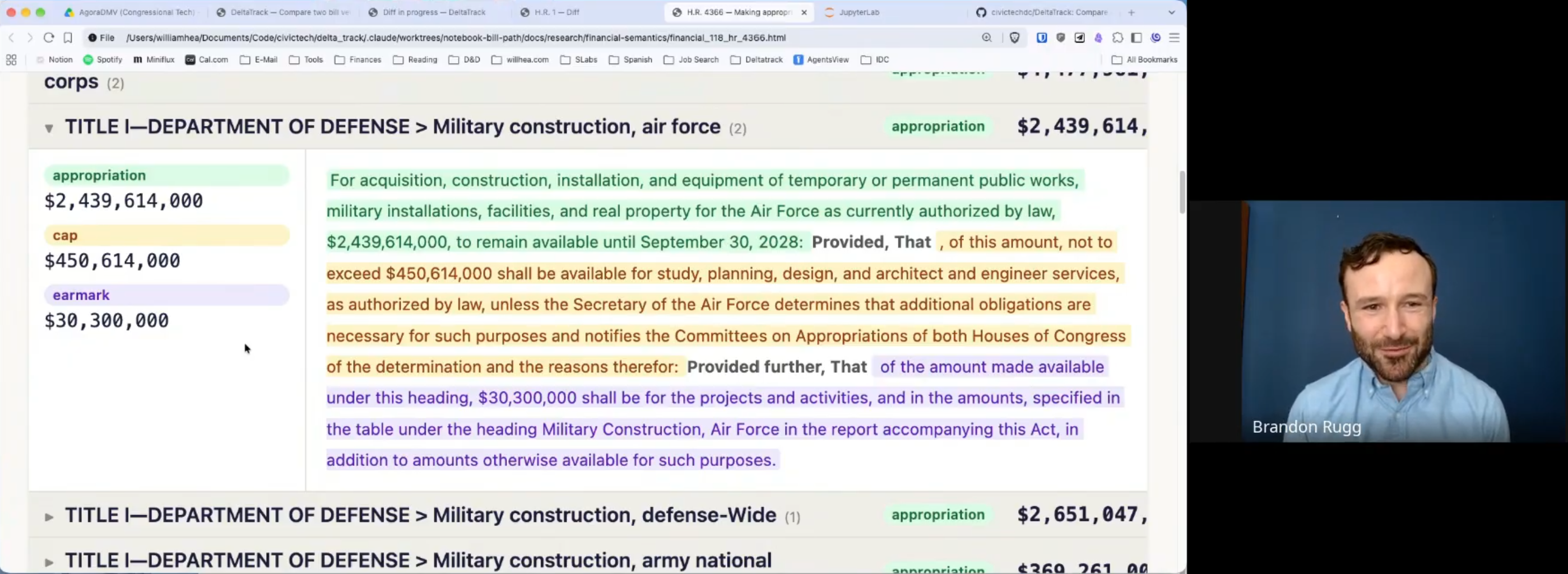
In October 2026, Civic Tech DC partnered with the POPVOX Foundation to host Lightning Demos: Budget & Approps Edition!. The Congressional Tech project presented two open-source tools for tracking changes to appropriations bills, including extracting dollar amounts and comparing different versions of legislation.
This is a good example of how you can partner with another organization to bring together people working on similar issues and give your project an opportunity to share its work with a new audience.
Example: WMATA and Ride Score DC
Sometimes opportunities come directly to Civic Tech DC organizers, who will share them with relevant projects. In March 2026, WMATA reached out about Civic Tech DC projects participating in an upcoming virtual Lunch and Learn series. The goal was to expand WMATA’s understanding of the different transit-oriented projects happening in the DC area, and Ride Score DC presented its work.
Connect with the Government
Section titled “Connect with the Government”One of the best things about being in DC is that it’s one of the few places in the country where you can connect directly with federal agencies. Agencies can be important partners for civic tech projects, especially if your project works with public data, improves access to government services, or tries to fix an existing government application.
When reaching out to government partners, be clear about what you are asking for. For example, WaterVoices DMV reached out to NOAA to introduce its work and explore opportunities to connect with the agency. Below is an example of the outreach email the team sent.